

Can You Supervise an Associate in Oregon? (And What It Actually Requires)
By Emelie Douglas, LPC, MBA · Founder, Sprout Your Practice
To supervise a professional counselor or marriage and family therapist associate in Oregon you need three things: an active Oregon license, 30 clock hours of post-master's supervision training, and a passing score on the Board's Supervisor Law and Rules Exam. How long you have been licensed determines which path you qualify under.
And then there is the rule almost nobody knows until it costs them. If supervision in any given month falls short of the requirements, every hour of client contact the associate logged that month is disallowed. Not reduced. Disallowed. I have watched a clinician lose a month of hard-won hours to a scheduling problem, and it is a genuinely awful conversation to have.
What are the minimum requirements to supervise in Oregon?
OBLPCT recognizes two routes, and the difference is mostly about the Supervisor Registry — the public list of LPCs and LMFTs available to supervise. You do not have to be on the Registry to supervise, but you do have to meet a comparable bar.
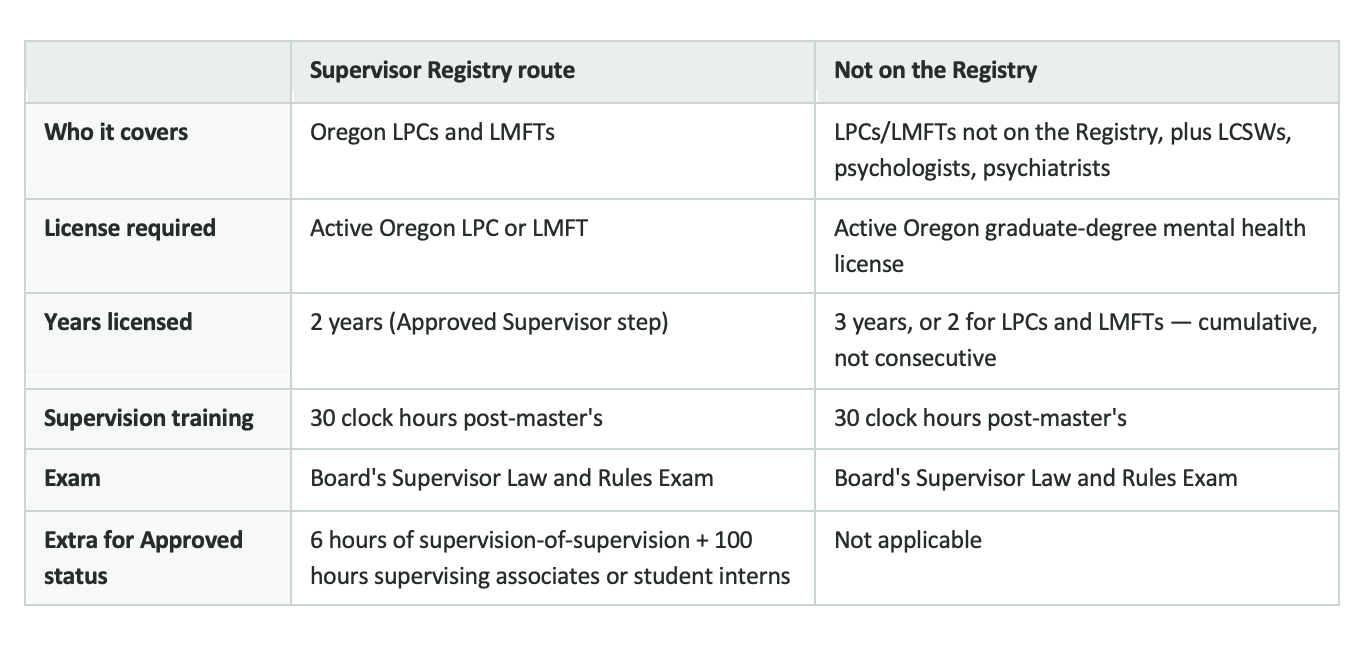
Two details that trip people up. First, MFT associate supervisors need supervision training that includes systems components — general supervision training is not automatically sufficient. Second, the two-year requirement is waived if you are an AAMFT or NBCC Approved Supervisor, or hold a CACREP-accredited doctorate in Counselor Education and Supervision.

What is the difference between a Supervisor Candidate and an Approved Supervisor?
Supervisor Candidate is step one: active Oregon license, 30 hours of training, passed exam. Approved Supervisor is step two, and it adds two years of active licensure, six documented hours of having your own supervision supervised by a Board Approved Supervisor, and 100 hours of documented post-licensure experience supervising associates or graduate student interns.
You can supervise as a Candidate. Approved status is what lets you sign off on other people's supervision-of-supervision and signals seniority. For most group practice owners bringing on their first associate, Candidate is the practical target.
One ongoing obligation applies to everyone who supervises: at least three clock hours of supervision-related training in every continuing education reporting period. The 30-hour course itself does not expire; the CE requirement does not go away.
Can an LCSW supervise a counseling associate? And what about CSWAs?
Yes to the first — LCSWs, psychologists, and psychiatrists can supervise OBLPCT registered associates under the not-on-the-Registry route, provided they have been Oregon-licensed for three years, completed the 30 clock hours, and passed the Board's exam.
CSWAs are a different animal entirely. Clinical Social Work Associates fall under the Oregon Board of Licensed Social Workers and OAR Chapter 877, not OBLPCT. In almost all cases a CSWA's plan supervisor must be an Oregon LCSW approved by that board, with two years of licensed practice, a passing score on that board's Oregon statutes and rules exam, and at least six hours of relevant continuing education completed within the five years before supervision begins. The hour requirements differ too — CSWAs need a minimum of 100 supervision hours, at least half of them individual.
If you run a group practice employing both counseling associates and CSWAs, you are managing two separate rulebooks with two separate boards, two exams, and two sets of forms. That is worth knowing before you make the offer, not after.
How often do you actually have to meet?
For OBLPCT associates, supervision must happen at least twice a month, in different weeks, with each meeting lasting no less than one hour. The monthly total scales with the associate's caseload: two hours in months with 45 or fewer direct client contact hours, three hours in months with 46 or more.
• At least half of the required monthly hours must be individual, one-on-one supervision. The rest may be group.
• Group supervision means six supervisees or fewer, with leadership that does not shift between supervisors.
• A staff meeting, team meeting, training seminar, discussion group, consultation session, or quality-review group does not count as supervision. This is the most common misclassification I see.
• Supervision must happen in person in a professional setting, or by live, synchronous, confidential electronic communication.
• Supervision of a given month's client contact must occur within that same calendar month.
What happens if you miss a month?
The associate loses the month. OBLPCT's language is direct: if supervision in a particular month does not meet the rule requirements, that month and all client contact hours accumulated during it are disallowed. At a full caseload that is potentially 60 or more hours out of the 1,900 they need, gone.
Three other ways hours evaporate, all of them preventable:
• Practicing before the plan is approved. The associate may not see clients until the Board notifies them that the registration plan is approved. Supervising someone before that is aiding unlicensed practice.
• A lapsed supervisor license. Experience completed under an unlicensed supervisor does not count toward licensure, and the associate bears the loss.
• Unreported interruptions. Extended illness, leave, or vacation on either side must be communicated to the Board in writing. If you are the one absent, either arrange coverage or the associate stops seeing clients.
What does this mean if you run a group practice?
Treat supervision compliance as an operational system, not a relationship. The rules are specific enough that good intentions will not save you, and the person who pays for a lapse is the associate, not you. Four things I would put in place before your first associate starts:
• A recurring calendar block for every supervision pair, twice monthly in different weeks, protected the way you would protect a client hour.
• A monthly hours check — direct contact hours and supervision hours reviewed together before the month closes, while a shortfall can still be fixed.
• A named backup supervisor who is already qualified, so illness or vacation does not stop the associate's clock.
• Contemporaneous supervision notes, written as supervision happens and retained at least three years. The Board can request them and you have 14 days to produce them.
Supervision is one of the most meaningful things you will do as a practice owner. It is also the place where a small administrative miss lands hardest on the person with the least power in the arrangement. Build the system so that never has to be their problem.
Frequently asked questions
How many associates can one supervisor take on?
OBLPCT does not publish a single cap, but the constraints are real: group supervision is limited to six supervisees, an associate may have no more than two supervisors per place of practice, and you must have the competence and time to genuinely oversee each caseload. Count the monthly hours before you say yes.
Does the 30-hour supervision training expire?
The 30-hour course itself does not expire once completed. But anyone supervising registered associates must complete at least three clock hours of supervision-related training in each continuing education reporting period to stay eligible.
About the author
Emelie Douglas is a Licensed Professional Counselor, MBA, and the founder of Sprout Your Practice. She built Sprout Therapy PDX from a solo private practice into a group of 40+ clinicians with ~90% annual retention, and served as president of the Oregon Counseling Association. She helps therapists and group practice owners grow businesses that are profitable, ethical, and sustainable — without burnout. Book a free consultation.