

By Emelie Douglas, LPC, MBA · Founder, Sprout Your Practice
Most therapists who ask me whether they should hire a business coach are starting one question too late. The better first question is narrower: what exactly is stuck, and is a coach the right person to unstick it?
A business coach helps you make decisions you have been avoiding and build systems you do not yet have. A coach cannot fix a bookkeeping problem, a licensing problem, or a burnout problem. Plenty of people will take your money trying. This is the guide I wish existed when I was deciding whether to spend money on help — including the part where the honest answer is not yet.
What does a business coach for therapists actually do?
A business coach works on your decisions and your systems. You stay the one doing the work; the coach shortens the distance between confusion and a choice you can act on.
That is a narrower job than most sales pages suggest, and the distinction matters because the four roles below get marketed as interchangeable. They are not.
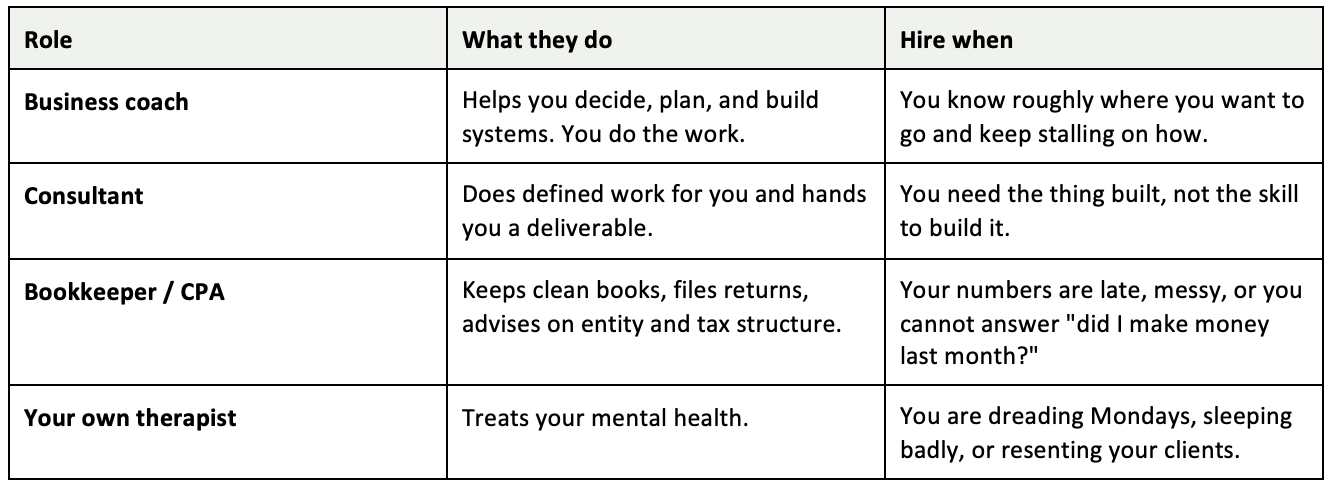
If you cannot tell which of these four you need, that itself is useful information — it usually means the problem hasn't been named yet. Name it before you spend money on it.
Does the credential matter, and which one?
The credential that matters most is operating experience: has this person actually run the thing they are coaching you on, at roughly the scale you are trying to reach?
Business coaching is unregulated in the United States. There is no licensing board, no state exam, and no required degree. Anyone can decide today that they are a business coach and start charging tomorrow. Voluntary credentials exist — the International Coaching Federation's are the most recognized — but no law requires them, and none of them certify that someone has met payroll, survived a payer audit, or fired someone kindly.
So the filter is not a certificate. It is three questions: Have you done this? At what size? Can I talk to someone you did it for?
Be specific about scale, because the advice diverges sharply. Someone who grew a solo caseload to full is genuinely useful if you are solo. They may have no idea what changes when you hire your fourth clinician and suddenly need an org chart, a supervision structure, and a real payroll calendar. Both are legitimate coaches. Only one is right for your problem.
What five questions should you ask on a consult call?
Ask these five, and listen for the weak version of each answer. A consult call is a work sample — how someone handles being questioned is roughly how they will handle being disagreed with six months in.
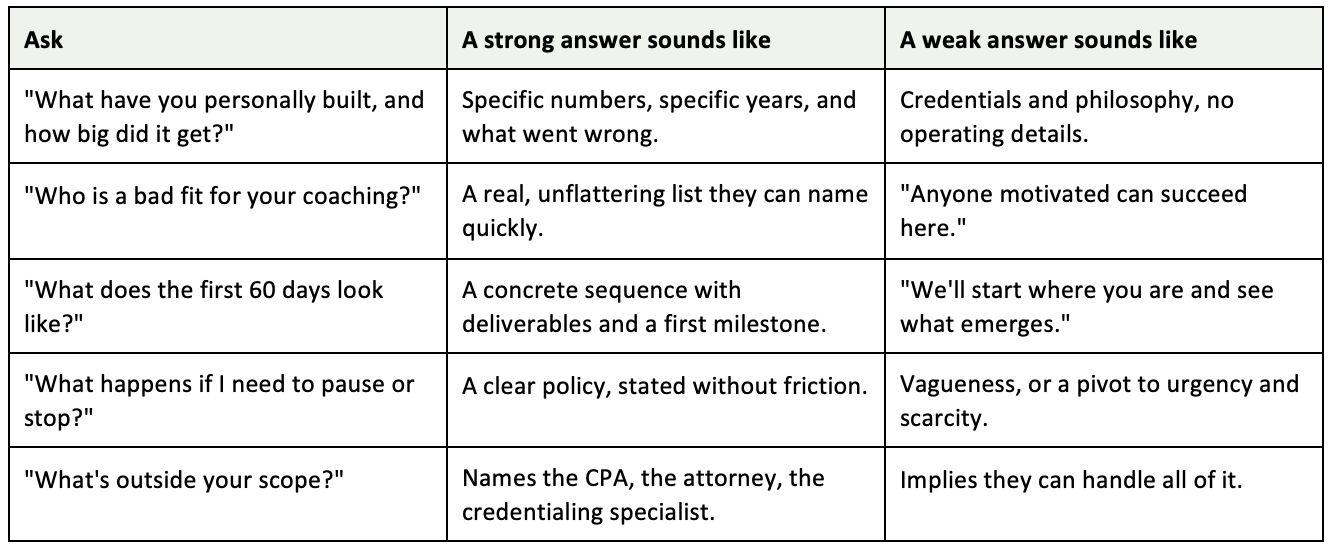
That second question is the one I would not skip. A coach who cannot name who they are wrong for either has not worked with enough people to notice the pattern, or has noticed and would rather not say.
When should you not hire a business coach?
There are four situations where coaching is the wrong purchase, and in three of them spending the money will actively delay the thing you actually need.
1. You are pre-licensure or pre-revenue. If you are still accruing hours toward licensure, your binding constraint is hours and supervision, not strategy. Strategy cannot compress a state-mandated timeline. Put the money toward supervision, exam prep, or your own therapy, and revisit coaching when you have a license and a few months of real revenue to make decisions about.
2. Your real problem is bookkeeping. If you cannot tell me whether you made money last month, no amount of coaching will help — we would spend our sessions reconstructing your books, at coaching rates, badly. Hire a bookkeeper who has worked with healthcare practices. Get a clean profit-and-loss statement. Then a coach becomes useful, because now there is something to read. I have some helpful tools available that might help with this, including a basic Financial Cashflow model.
3. You are in acute burnout. This is the one I feel strongly about. If you are exhausted, cynical about clients, dreading your calendar, or wondering whether you should leave the field, a growth plan is the wrong intervention. Growth plans in acute burnout tend to accelerate the crash, because they add load to a system already past capacity. What you need is your own therapist, a real reduction in caseload, and possibly time off. That is not a detour from building a sustainable practice. It is the first step of it.
4. You already know the answer and want permission. Sometimes people hire a coach to be told that the thing they have decided is allowed — to raise rates, to let someone go, to stop taking a payer. That is a legitimate need and you can meet it far cheaper: a peer consultation group, a trusted colleague, or a single paid strategy session. You do not need a six-month engagement to be told you are allowed to charge what your work is worth.
A fifth, less common case: you want someone to do the work. That is a consultant or a hire, not a coach. Buying coaching when you needed capacity leaves you with a plan and no one to execute it.
I want to stay on the burnout one for a moment, because it is the scenario I see most often and the one the coaching industry handles worst. Burnout frequently presents as a business problem. It sounds like "I need to restructure my caseload," or "I need better systems," or "maybe I should hire so I can step back." Sometimes those are the right moves. But if you are also not sleeping, snapping at people you love, or feeling nothing at all when a client improves, the restructure will not touch the thing that is actually wrong. Build the business plan after you have stabilized, not as a substitute for stabilizing. Any coach who takes your money without asking how you are doing is not paying attention.

How do you tell if it's working?
Give it six to eight weeks, then check against something more specific than whether you like the person. Liking your coach is pleasant and is not the same as progress.
By that point you should be able to point to at least two of these: a decision you had been circling that is now made, a system or document that exists and is in use, a number you now track that you did not before, or a boundary you have actually held. Insight alone does not count. Feeling clearer is a real experience, but if nothing in the practice has changed in two months, something is off.
Yellow flags at that stage: sessions that feel good but produce no artifacts; advice that stays general when you ask for specifics; a coach who never disagrees with you. Red flags: pressure to upgrade to a larger package before the current one has delivered anything, or a coach who reframes your doubts as a mindset problem. Doubt at week six is data. A good coach will treat it that way and ask what is missing.
If it is not working, say so directly. A professional will either adjust or agree the fit is wrong. How that conversation goes tells you most of what you need to know.
What does coaching cost, and what shapes the range?
Prices vary widely enough that any single number I quoted would mislead you. What is predictable is what drives the range, and knowing the drivers lets you tell a fair price from a padded one.
Four things move the number: format (one-to-one costs more than a group cohort, which costs more than self-paced material), access (weekly with messaging between sessions costs more than monthly), whether anything gets built for you (templates and documents delivered are consulting hours, priced accordingly), and seniority (someone who has run a 40-clinician practice prices differently than someone who has run a solo one — sometimes justifiably).
Three things to confirm in writing before you sign: total cost including any onboarding fee, what happens if you need to pause, and exactly what is delivered versus what is guidance. If a proposal is vague on any of the three, ask again. Reluctance to be specific about money is worth taking seriously in someone you are hiring to help you be specific about money.
How I work
I coach therapists and group practice owners on the operational side of growth: hiring, pay structure, systems, and the decisions that get avoided. I built Sprout Therapy PDX from a solo practice to a group of more than 40 clinicians, so the advice comes from having done it, including the parts I got wrong.
I am also a bad fit for some people, and I would rather say so on a consult call than take the engagement. Book a free consultation and we will figure out which it is.
FAQ
Is a business coach worth it for a solo therapist?
Sometimes, but the test is specific. Coaching pays off for a solo therapist when the constraint is a decision — raising rates, leaving a panel, whether to hire — and not a capacity or skills gap. If your caseload is thin because your referral sources are thin, a coach can help you build a pipeline. If it is thin because you are three months from licensure, wait.
How long should I work with a business coach?
Long enough to build the thing and see whether it worked, which is usually one to two quarters for a defined project. Be cautious about open-ended engagements with no exit milestone. A good coach should be able to describe what "done" looks like, and should be planning for you not to need them.
About the author
Emelie Douglas is a Licensed Professional Counselor, MBA, and the founder of Sprout Your Practice. She built Sprout Therapy PDX from a solo private practice into a group of 40+ clinicians with ~90% annual retention, and served as president of the Oregon Counseling Association. She helps therapists and group practice owners grow businesses that are profitable, ethical, and sustainable — without burnout. Book a free consultation.