

By Emelie Douglas, LPC, MBA · Founder, Sprout Your Practice
Here is the test, and you can run it this afternoon with your intake log: count the qualified inquiries you received each of the last three months, then divide by the number of new clients one full-time clinician needs per month to reach and hold a full caseload. If that ratio is below about two to one, your pipeline cannot feed a new clinician yet — and hiring will convert a referral problem into a payroll problem.
I have written elsewhere about the signs you are ready to hire and what hiring a new clinician actually costs you. This post is only about the demand side: whether the revenue will show up to meet the cost. It is the prerequisite almost nobody checks, and it is the reason most first hires feel like a mistake for the first two quarters.
What is the pipeline test, exactly?
Take your monthly qualified inquiries and compare them against what one clinician consumes. The number you need is larger than it feels, because a caseload is not a bucket you fill once — it leaks continuously.
Work it in this order:
1. Set the target caseload. Say 25 client sessions per week for a full-time clinician.
2. Account for turnover. Clients finish, move, or drift. If a typical episode of care runs about four months, a 25-client caseload sheds roughly six clients a month at steady state.
3. Account for conversion loss. Not every inquiry becomes a client. Between the first message and the fourth session you lose people to cost, schedule, fit, insurance, and simple change of mind.
4. Do the division. If about 45% of qualified inquiries become ongoing clients, replacing six clients a month takes roughly 13 qualified inquiries a month — for one clinician, just to hold steady.
Every number in that sequence is illustrative. Replace all four with your own — your caseload target, your average episode length, your conversion rate, your definition of qualified — before you make a decision on it. The arithmetic is the transferable part, not my inputs.
Laid out, using those illustrative inputs:
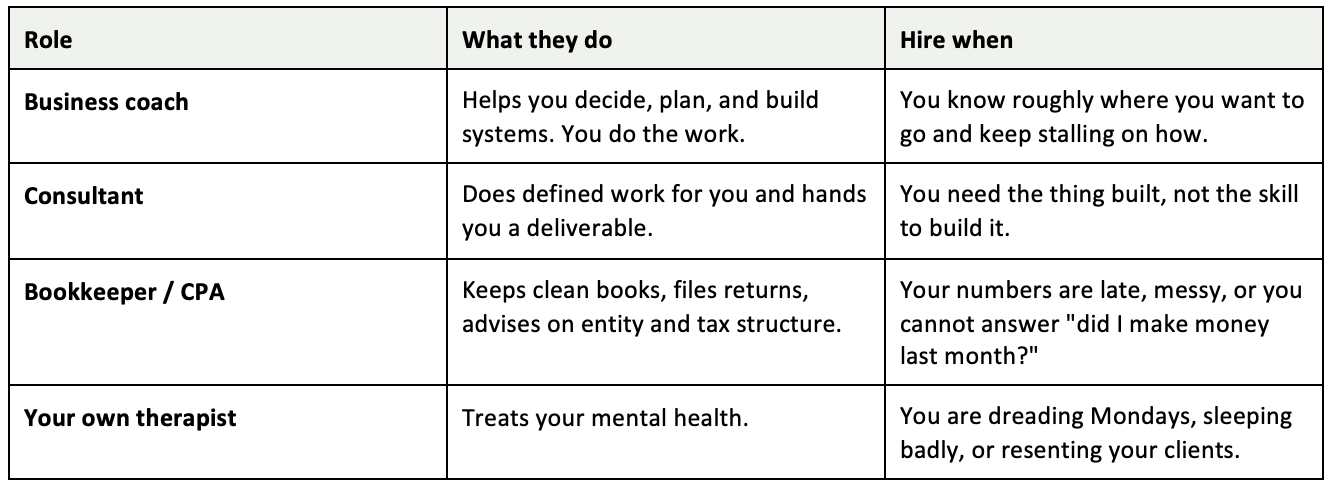
Two implications people miss. First, holding steady and building are completely different demands: getting a new clinician from zero to 25 clients requires those 25 on top of ongoing replacement. Second, this is per clinician. If you are already relying on your full pipeline to keep your own caseload full, a new hire needs net-new demand, not the existing flow rearranged.
Why is "I'm turning people away" a weaker signal than it sounds?
Turning people away only predicts a fillable caseload if the people you turn away could actually be seen by the person you are about to hire. Most owners never check that, and the mismatch is where hires go wrong.
Go back through your last 30 declines and sort them by why:
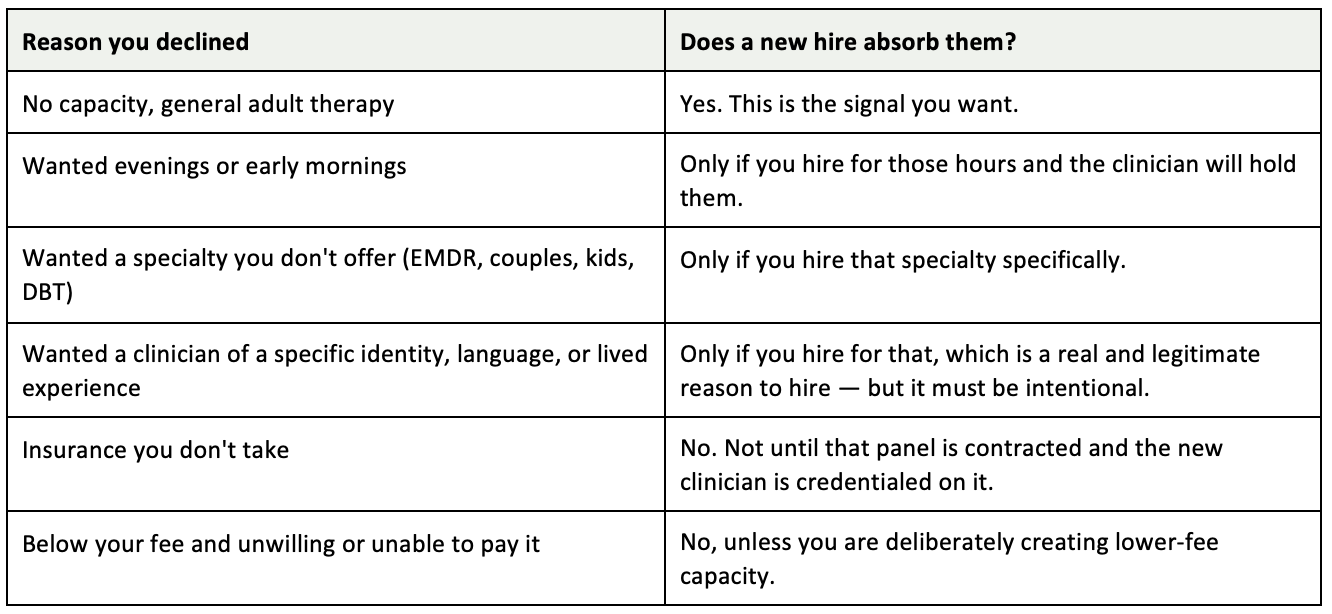
If most of your declines land in the bottom three rows, you do not have a capacity problem. You have a scope, panel, or pricing problem, and a new clinician will sit with open hours while you keep declining people for reasons the hire did not change.
The credentialing row deserves its own warning: a newly hired clinician is typically not billable on your payer contracts on day one. Credentialing can take months, and a caseload plan that assumes insurance clients from week one is a cash-flow problem waiting to happen.
How long does a full caseload actually take to build?
Plan on three to six months to a full caseload for a new clinician with a healthy pipeline behind them, and expect the first month to be very light. Owners routinely budget for one month of ramp and are then surprised twice: once by the timeline, and once by what the timeline costs.
The cost is the part to model. If your clinician is a W-2 employee, you are paying wages, taxes, and benefits against a caseload that is half full for a quarter or more. If you pay a percentage split, the ramp costs you less in cash but exposes the clinician to real income instability, which is its own retention risk — an associate who cannot pay rent in month two starts job-hunting in month three, and you have bought yourself a vacancy instead of a hire.
Two things shorten the ramp more than anything else:
• A real internal waitlist you can transfer from. If clinicians who are full can hand off warm referrals in week one, ramp compresses dramatically. This is the single biggest advantage a group has over a solo practice.
• Credentialing completed before the start date. Start the paperwork the moment you have a signed offer, not the week they begin.
Also build in the gap between scheduled and delivered. Reported no-show and late-cancellation rates in outpatient mental health commonly land in the 20–30% range, and peer-reviewed research finds attendance at initial appointments is meaningfully worse than at established ones. Whatever your own rate is, a caseload plan built on scheduled sessions rather than attended ones will overstate revenue. Pull the real number from your EHR and use that.
Which referral sources fill a caseload fastest?
Ranked by how quickly they convert, from fastest to slowest:
1. Internal transfers from your own full clinicians. Already screened, already trusting the practice, no acquisition cost. Fastest by a wide margin.
2. Direct inquiries from your website and directory profiles. These people are actively looking and have chosen you. Conversion is high; volume depends on how findable you are.
3. Colleague referrals from other therapists. High fit, high trust, moderate volume. Slower to start because it depends on relationships, but durable once established.
4. Payer directory listings. Steady and often high-volume, but only after credentialing, and fit is variable because clients are filtering by coverage first.
5. Prescribers and primary care. Valuable and often underused, but slow to build and dependent on a specific relationship rather than the institution.
6. Community organizations, schools, and nonprofits. The slowest to convert and the most relationship-dependent. Worth building for mission reasons and long-term stability; not a plan for filling a caseload this quarter.
The practical read: if your pipeline is concentrated in rows four through six, your ramp will be slower than your spreadsheet says.
How do you fix a thin pipeline before you post the job?
Give yourself one full quarter of pipeline work before you write a job description. This is the least exciting recommendation I make and the one that saves the most money.
Concretely, in that quarter: get every clinician's directory profile current and specific rather than generic; start the credentialing conversations for any panel you are counting on; build an actual internal waitlist with names rather than a vague sense that people are waiting; track inquiries in one place so you have three months of real data instead of an impression; and ask your three best referral sources directly what they need more of.
Then re-run the test. If the ratio holds, hire with confidence. If it does not, you have lost a quarter and saved yourself from carrying an underfilled salary for two.
One honest caveat: sometimes you hire before the pipeline is fully proven, on purpose — because a specific excellent person is available now, or because the specialty you are adding will create its own demand. That can be the right call. Just make it knowingly, with cash reserves sized for a slow ramp, rather than discovering the gap in month three.

FAQ
How many inquiries per month do I need to hire one clinician?
Run the math above with your own numbers rather than adopting mine. The structure is: replacement need per month, divided by your inquiry-to-client conversion rate, plus the additional volume required to build from zero during the ramp. For most practices the honest answer is more than they expect, and the figure is worth calculating before it becomes a payroll obligation.
Should I hire when my own caseload is full but the practice pipeline is thin?
Usually not yet. A full personal caseload tells you you are at capacity; it does not tell you there is unmet demand a second clinician can serve. The distinction matters most when your caseload is full of clients who came specifically for you, your specialty, or your fee — none of which transfers automatically to a new hire.
About the author
Emelie Douglas is a Licensed Professional Counselor, MBA, and the founder of Sprout Your Practice. She built Sprout Therapy PDX from a solo private practice into a group of 40+ clinicians with ~90% annual retention, and served as president of the Oregon Counseling Association. She helps therapists and group practice owners grow businesses that are profitable, ethical, and sustainable — without burnout. Book a free consultation.