

By Emelie Douglas, LPC, MBA · Founder, Sprout Your Practice
Here is the rule that governs almost every version of this question, and it runs in both directions: the session is governed by the law of the place your client is sitting and the law of the place you are sitting. Two locations, two sets of rules, and you need authority in both.
Most coverage of this topic gets the client half right and drops the other one. That omission is the expensive part, because your own location independently determines three separate things: whether you are licensed to practice, whether the session is reimbursable, and whether your malpractice coverage applies. A clinician working from a hotel in Denver has an Oregon client and an Oregon license and may still be out of compliance for that session.
Every Portland-metro practice hits this — a client moves across the river, a strong candidate is Washington-licensed only, a clinician takes a three-week trip. What follows is what I confirmed against the boards' and agencies' own materials as of September 2026, including one answer that surprised me.
What does "licensure follows location" mean in each direction?
Oregon's board states the client half plainly: an Oregon licensee, registered associate, or permitted practitioner is authorized to practice in person or electronically with clients who are within the State of Oregon. If you or your client goes elsewhere, Oregon "cannot authorize practice within another state" — that other jurisdiction decides.
The clinician half is the mirror image. When you render a session from another state, that state's board governs whether you may practice from there. Some states allow short-term practice under temporary-practice exemptions; others require full licensure; many have no clear rule at all. Washington works the same way from its side: whether an out-of-state provider may treat someone physically located in Washington depends on Washington's rules, and Washington generally requires a Washington license or a narrow exception such as consultation with the client's treating provider.
Two practical consequences. Geography is not a loophole in either direction — being fifteen minutes from the border changes nothing legally. And Oregon requires no special telehealth certification to practice teletherapy with Oregon clients. The barrier is licensure, not a telehealth credential.
What are the three permissions you actually need?
Licensure, reimbursement, and malpractice coverage are three separate permissions, and holding one tells you nothing about the other two. Practices tend to check the first, assume the second, and forget the third entirely.
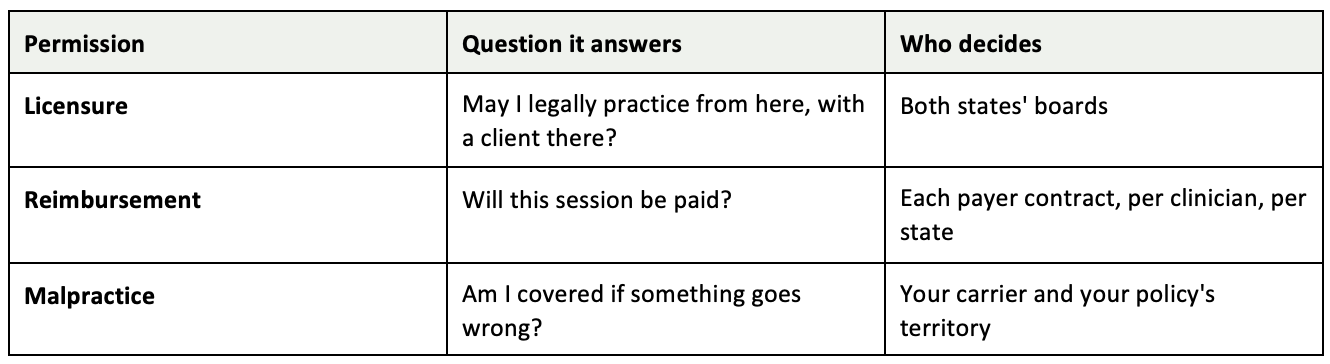
On reimbursement: payer contracts commonly require that you hold the licenses required both where the member is located and where you are physically located. Some restrict rendering to a specific list of states. Many require the clinician be physically inside the United States. Medicaid, Medicare, and commercial plans each answer differently, and the answers live in contracts rather than in public rules — so confirm in writing, per plan and per clinician, before the first session. Treat anything a payer tells you by phone as unconfirmed.
On malpractice: check your policy's territory. Many professional liability policies cover the United States only, which makes international work uncovered even where a board and a payer would allow it. Confirm your carrier covers the state you are rendering from, for the specific dates you are there.
What are the four scenarios a Portland practice actually faces?
Scenario 1: An established client moves to Vancouver.
Once they are physically in Washington for sessions, you need Washington authority and licensure. Without it, the ethical path is a planned transition — a referral, records handled properly, and enough sessions to close well rather than an abrupt stop. Washington has no Oregon-style short-term permit that solves this for ongoing care, so plan the transition rather than hoping.
Scenario 2: A Washington client wants to see you, and you are Oregon-only.
Either they attend sessions while physically in Oregon, or you get Washington-licensed, or you refer. There is no version where you see them at their kitchen table in Vancouver on an Oregon license.
Scenario 3: You travel, and your Oregon clients stay put.
This is the half most practices have no policy for. Before you take sessions from another state, you need a documented answer on all three permissions: whether that state's board permits you to practice from there, whether each affected payer will pay for a session rendered from there, and whether your coverage extends there for those dates. If any one comes back unclear or unfavorable, the affected sessions pause and coverage gets arranged. Cash-pay work is often the only piece that survives an ambiguous answer, and even that depends on the destination board.
Scenario 4: A Washington-licensed clinician has a client temporarily in Oregon.
This is the one Oregon built a tool for. Oregon issues a limited permit to clinicians actively licensed elsewhere, created by House Bill 3300 (2023).
The board's qualifying example is the summer-break case: a Minnesota-licensed counselor providing biweekly telehealth to a college student home in Portland for June through August. Another is continuity of care for a relocated long-term client, delivered over about a month while transitioning them to a local provider.

What about unlicensed and associate staff?
They are more restricted than licensed clinicians, and there is no workaround. On July 1, 2026, OHA implemented a rule change clarifying that unlicensed behavioral health providers — board-registered associates, QMHAs, QMHPs, peer support specialists, CADCs, and problem gambling specialists — must be physically located in Oregon while working for an agency holding an OHA Certificate of Approval (COA), reflected in OAR 309-019-0125 and 309-019-0130.
Two things to be precise about. OHA frames this as a clarification, not a new requirement: providers "have always been required to be physically located in Oregon while caring for people in Oregon." So there is no grace period. And no compact, license, or permit creates a pathway around it — an associate cannot render from Washington under any arrangement.
A separate and larger change lands July 1, 2027, when board-registered associates will be able to serve Medicaid members only if licensed or working for a COA-holding agency. That deserves its own discussion, and it is coming next month.
What changes when you hire a Washington-licensed clinician?
Three things, none automatic: the license, the associate pathway, and the payer contracts.
The license. A Washington-licensed clinician cannot see your Oregon clients. If your caseload is mostly Oregon, you are hiring someone who needs Oregon licensure before they can do most of the job — so treat that timeline as part of the ramp, not an afterthought.
The associate pathway. The two states count supervised experience differently, and the hours do not port. Washington requires 3,000 hours of postgraduate supervised experience with at least 1,200 in direct client counseling and 100 under immediate supervision, with a credit of 500 hours for CACREP graduates (WAC 246-809-230). Oregon counts direct client contact hours — roughly 1,900 under the associate registration pathway, with a higher figure for direct and reciprocity applicants (OAR Chapter 833). An associate halfway to licensure in one state is not halfway in the other, and a supervisor approved in one state is not automatically approved in the other. Employ both, and you are running two rulebooks — three if you also employ social workers, who fall under a different Oregon board entirely.
The payer contracts. Credentialing is state-specific and plan-specific. A dually licensed clinician is not automatically in network in both states.
Will the Counseling Compact fix this?
Not for Oregon, and the answer is more definitive than most coverage suggests. Oregon's board addresses it on its own site: "Will Oregon join the Counseling Compact? The short answer: no."
The reasoning is substantive. The compact's language conflicts with Oregon's Constitution, statutes, and administrative rules, and those conflicts could not be resolved while preserving Oregon's standards. The board also cites concerns about handing regulatory authority to an external commission and the risk to Oregon's own efforts to reduce licensure barriers, which uniform compact entry requirements would jeopardize. HB 3351 (2025) was introduced and failed.
Washington has enacted compact legislation but, as of September 2026, is not among the states actually issuing privileges. The compact is live for licensees in nine states: Arkansas, Arizona, Georgia, Indiana, Louisiana, Minnesota, Ohio, Tennessee, and Wyoming, with roughly 29 more states and D.C. still completing the technical steps.
Two separate lists exist here, and conflating them causes real errors: states that have enacted the compact, and the shorter list operational for privileges. A privilege works only between two states that are both operational. The compact also requires being licensed in and residing in your home state, and pre-licensure associates are ineligible regardless of title.
Planning implication: do not build a two-state staffing strategy on the compact reaching Oregon. Build it on dual licensure.
How do you decide, each time?
Run the same four steps in the same order, and write down the answers.
1. Permission. Is there a documented pathway — full licensure, a temporary-practice allowance, or a permit — in both locations?
2. Conflicts. Do the destination's rules, the payer contracts, and your malpractice policy all agree? Any one of the three can veto.
3. Capacity. Can you actually meet your obligations from there — emergency response, a private setting, secure access, documentation?
4. Documentation. What did you verify, from which source, on what date?
One rule holds the whole thing together: absence of information is not permission. If a jurisdiction's rules cannot be confirmed, the pathway is unclear, not open. Silence from a board is not a yes.
What should you have in place before this comes up?
A location check at the start of every telehealth session — where the client is, and where you are. Document both. Ten seconds, and it is your evidence of compliance.
A license matrix listing every clinician, every state they hold, expiration dates, and which payer contracts they are credentialed under in each.
A written travel process — advance notice to a supervisor, verification of all three permissions before sessions are approved, and a default of pausing sessions when an answer is unclear.
A reverification process — a process to reverify details whenever a client moves, the clinician moves, a payer revises its location rules, a board issues new guidance, or a client's risk level shifts in a way that affects emergency planning. We check for bigger picture changes at least annually when we perform our policy reviews.
Verify before you act
Licensure, compact, Medicaid, and payer rules change, and this post is a starting point rather than an authority. I’m writing this post in September 2026, and things are always changing. Before you make a hiring, licensing, travel, or billing decision, confirm current requirements directly with the Oregon Board of Licensed Professional Counselors and Therapists, the Washington State Department of Health, the Counseling Compact Commission, and Oregon Health Authority — and consult your attorney for anything contractual and your carrier for anything about coverage. If you employ social workers, check the Oregon Board of Licensed Social Workers separately; the rules are not the same.
FAQ
Can I see a client who moved to Vancouver if I'm only licensed in Oregon?
Generally no, not while they are physically in Washington for sessions. Washington requires authority to practice there, and Oregon's board is explicit that it cannot authorize practice in another state. Your options are getting Washington-licensed, having the client attend from Oregon, or planning a transition to a Washington provider. Confirm your situation with both boards.
Can I keep seeing my Oregon clients while I'm traveling out of state?
Only if you can document three things: that the state you are in permits you to practice from there, that each affected payer will reimburse a session rendered from there, and that your malpractice coverage extends there for those dates. If any one is unclear, pause those sessions and arrange coverage. Oregon licensure alone does not answer the question, because the state you are sitting in also governs.
About the author
Emelie Douglas is a Licensed Professional Counselor, MBA, and the founder of Sprout Your Practice. She built Sprout Therapy PDX from a solo private practice into a group of 40+ clinicians with ~90% annual retention, and served as president of the Oregon Counseling Association. She helps therapists and group practice owners grow businesses that are profitable, ethical, and sustainable — without burnout. Book a free consultation.